
August 2026
Diana and Cupid (1761) — Pompeo Batoni
An allegory of restraint that paints the surrender inside it.
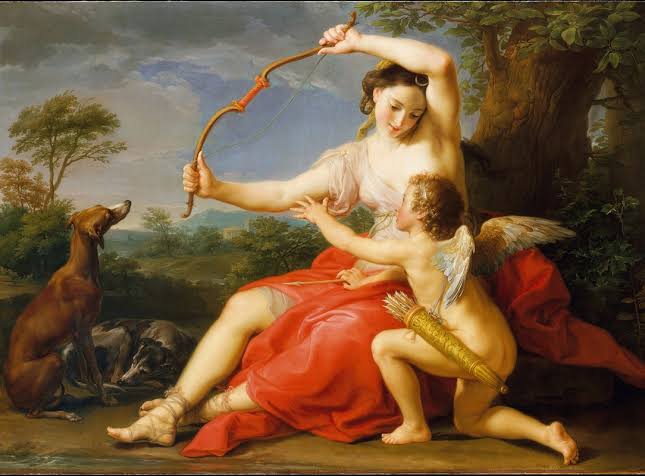
Pompeo Batoni, the most sought-after painter in 18th-century Rome, painted Diana and Cupid in 1761. The goddess of the hunt lifts her bow high above her head, just out of reach, while Cupid presses close against her, his little wings still ruffled, one hand reaching up her bare arm to win it back. The classical influence dominates: Diana's languid, reclining grace is borrowed from an ancient marble of the sleeping Ariadne in the Vatican, and her wine-red drapery pools around her like something half-undone. But look at her face — she isn't struggling. She gazes down at the boy with a soft, knowing tenderness, more caress than refusal.
That's the seduction of it. On the surface it's an allegory of restraint: chaste Diana disarms Love, lifting the bow "to make him rest for a while." Yet Batoni paints the surrender inside the resistance — the closeness of their bodies, the warmth of her cheek, the sense that holding Cupid off is really just another way of holding him. The detail that makes it ache — the faithful hound at the left, gazing up at the pair. Batoni's patron, the animal-loving banker Sir Humphrey Morice, asked to be woven into the myth as his own dog, keeping watch while love is lulled, for one tender moment, to sleep. The painting hangs in the Metropolitan Museum of Art, New York.